
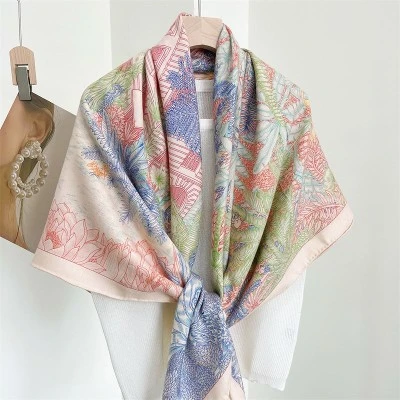

The origins of the 'yunjian' (literally "cloud-shaped shoulder cape") can be traced back to the pre-Qin and Han dynasties, with its earliest visual depictions appearing in Sui Dynasty murals at Dunhuang. From the Yuan Dynasty onwards, it evolved into a distinct accessory worn draped around the neck and over the shoulders.
By the Yuan Dynasty, the 'yunjian' had acquired a standardized form and was incorporated into the official system of attire; the 'History of Yuan' (Treatise on Carriages and Clothing) describes its design as resembling four cloud-shaped panels hanging downwards. Over time, it came to be worn primarily during seasonal festivals or weddings. Its popularity peaked during the Ming and Qing dynasties, when it became an essential part of wedding attire and was worn across all social strata. During the Qing Dynasty, 'yunjian' crafted by artisans in Guangzhou-such as the famous "Manila shawls"-were exported to Europe via the Maritime Silk Road, becoming a symbol of Western fashion.
After the founding of the Republic of China, the 'yunjian' gradually faded from everyday wear, becoming reserved for traditional opera performances and weddings. The accessory typically features a "four-part *ruyi*" (scepter-head) design, consisting of two layers comprising eight cloud-shaped panels; each panel is embroidered with motifs ranging from flowers, birds, and insects to scenes from theatrical stories. Creating an exquisite *yunjian* is a time-consuming process requiring exceptional craftsmanship. The embroidery employs a wide variety of techniques-such as couching, stem stitch, split stitch, pine-needle stitch, seed stitch, gold-thread outlining, and satin stitch-resulting in a diverse array of styles. In recent times, driven by the "Guofeng" (traditional Chinese style) trend, the *yunjian* has made a comeback, appearing at events such as fashion weeks.


